The San Jose-Sunnyvale-Santa Clara metro area had about 1.18 million nonfarm jobs in July 2026, according to Bureau of Labor Statistics data for the San Jose area. About 131,000 of those were in manufacturing, and roughly 280,000 were in professional and business services. That mix of engineering offices, R&D labs and production floors creates a break room problem a single snack machine can’t solve.
Micro market vending is one answer. It replaces a row of machines with an open, self-service store inside your building. Here is how it works and how to tell if it fits your South Bay site.
What micro market vending looks like
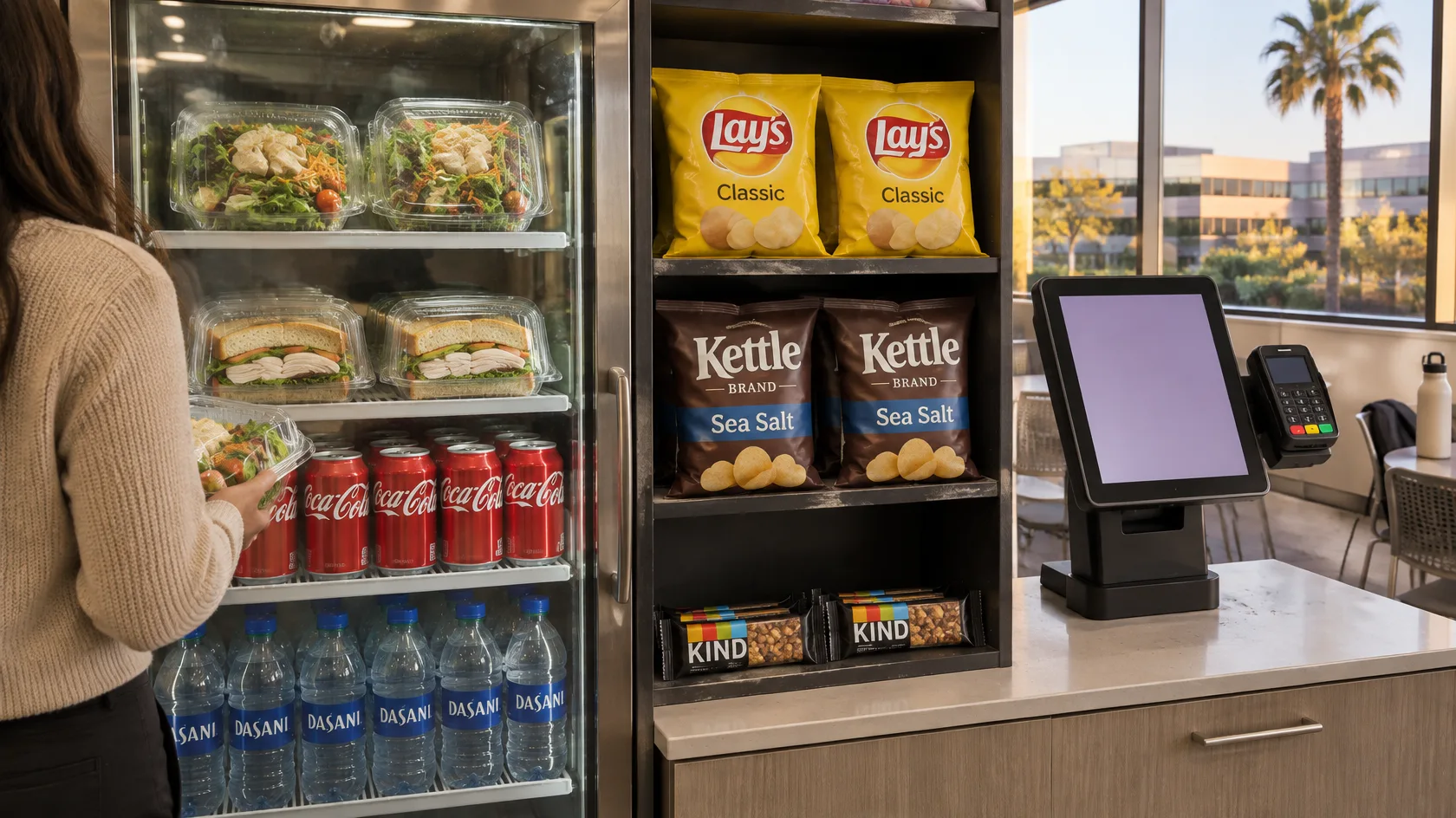
A micro market looks like a small convenience store built into your break room. Instead of pressing a button and waiting for a coil to turn, employees walk up to open shelves and glass-front coolers, pick up what they want, and pay at a self-checkout kiosk.
Because products sit on open shelves, people can read labels, compare options and grab several items at once. That makes a big difference for anyone with dietary needs. PVS Refreshments micro markets in Santa Clara carry gluten-free, vegan and vegetarian snacks alongside fresh food, brand-name drinks and everyday sundries.
How checkout and payment work
The kiosk is the heart of the market. Employees scan each item, then pay with a credit or debit card, a mobile wallet or an employee card. There is no cashier, so the market can stay open around the clock.
That matters in the South Bay, where a lot of work doesn’t happen nine to five. Manufacturing shifts can run overnight, engineers stay late before a release, and lab teams come in on weekends. A micro market serves all of them the same way.
PVS markets also include a loyalty rewards program, so employees earn rewards on their purchases.
Security and restocking
Office managers usually ask two questions first: what stops theft, and who keeps it full?
On security, micro markets work best in areas limited to employees, such as a badge-access break room or an interior floor. When you talk to providers, ask how they monitor the market and handle shrink, and what happens if losses climb.
On restocking, the system does most of the work. PVS markets run on a cloud-based system that records every purchase and alerts us when items run low. Our drivers use that data to pre-kit each restock at the warehouse, so they arrive with what your market actually needs. If you run a plant with round-the-clock crews, our post on vending and micro markets for 24/7 manufacturing facilities covers shift-specific planning.
Fresh food is where micro markets stand out
A snack machine handles chips and candy well. A micro market can also carry salads, sandwiches, wraps and other fresh items that need refrigeration and quick turnover.
PVS works with a local commissary to supply fresh food, and during onboarding we build a customized menu around your team. For a San Jose office far from a cafe, or a campus where lunch means getting back in the car, that can save employees real time.
How to size a micro market
There is no single formula. The right size depends on headcount, how many shifts you run, how much floor space you have, and whether people eat lunch on site. A good provider will look at your space and usage before recommending:
- How many glass-front coolers you need
- Shelf space for snacks versus fresh food
- Where the kiosk goes so lines don’t block the doorway
- Whether to add a coffee station or a frozen treat machine
Start with your busiest hour. If a line would form at a single vending machine, a micro market is probably worth a look.
Micro market vs. vending machines
Vending machines still make sense for small teams, tight spaces and public areas. They’re secure, compact and simple to run.
Micro markets suit larger or more varied teams that want fresh food, more choice and a store-like experience. The line between the two is getting thinner. A 2026 industry census from the National Automatic Merchandising Association found that the distinctions between traditional vending, smart coolers and micro markets are becoming less rigid, with operators treating them as complementary tools. NAMA estimated the U.S. convenience services industry at $31.1 billion in 2025, up from $26.6 billion in 2023.
Many South Bay sites end up with both: a micro market in the main break room and a machine or two in a warehouse or lobby.
Plan a micro market for your South Bay office
PVS Refreshments has more than 20 years in the refreshment industry and installs, monitors and restocks micro markets for offices, campuses and plants across San Jose, Santa Clara and the Bay Area. To see what a market could look like in your space, explore our micro market service or call (844) 527-4800.